The Promotion Trap
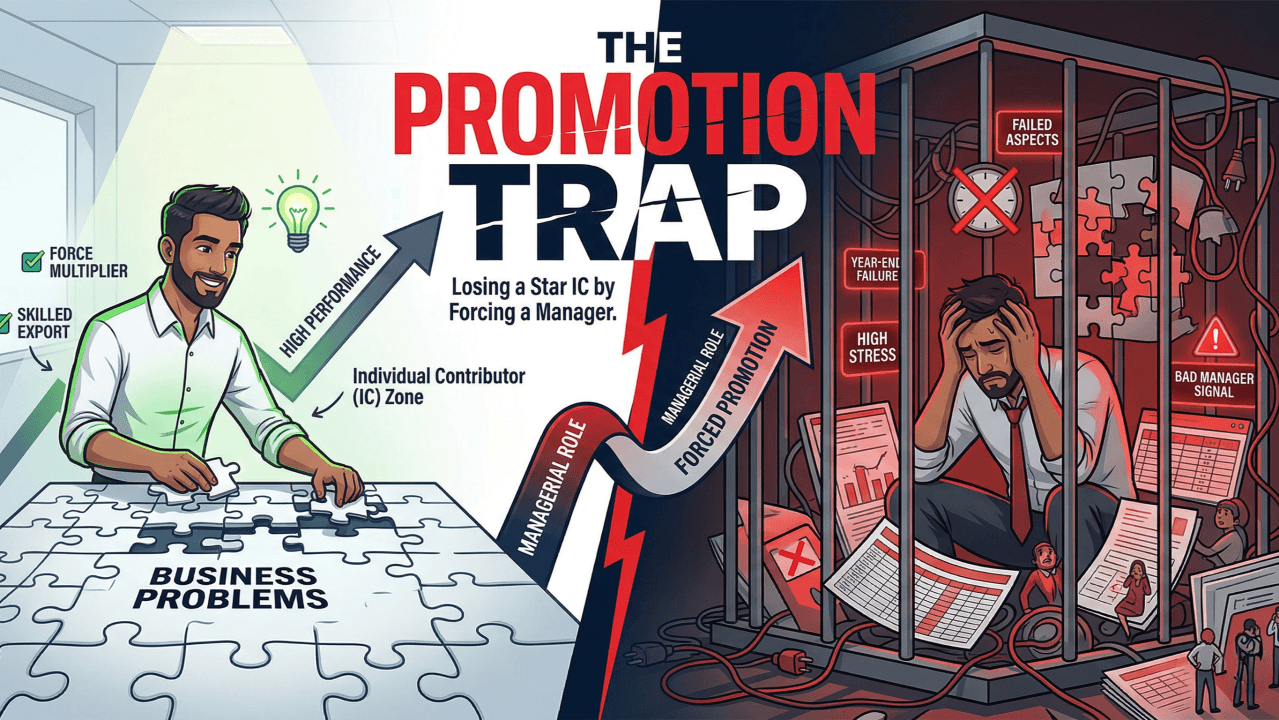
Ahmed is a skilled senior employee who consistently solves business problems in a notable way. His manager trusts that, no matter the problem, Ahmed will find an effective approach to tackling it. Ahmed has been working as a senior employee for a couple of years now, and during that time he has built a great skill set. He has faced many known and unknown issues, all of which he was able to solve. His team trusts him and is confident that as long as Ahmed is part of the discussion, they are in good hands.
Ahmed is also a force multiplier for his team. He supports them proactively and helps them grow. Over time, he has shaped his team through his exceptional expertise. His manager observed that Ahmed deserves a promotion, and when beginning discussions with senior leadership, they recommended Ahmed for a managerial role.
Ahmed’s manager was happy to inform him about the promotion offer. Surprisingly, Ahmed was not pleased with the news. He told his manager that he was not interested in the managerial track and was much more interested in an individual contributor (IC) role. After a couple of meetings, the manager pressured Ahmed to take on the managerial role; Ahmed found himself forced to accept, and he ultimately did so.
After a couple of months, the manager came to Ahmed and told him that he had failed in many aspects and needed to work on leveling up those areas. Ahmed tried for a couple more months, but he was stressed, spending a great deal of time on problems—trying to understand them and find proper ways to deal with them. Again, after a few months, the manager came to Ahmed and told him that: "he had failed to prove himself, and the first-year data signaled that Ahmed was a bad manager"
This quick story is a common problem that lots of employees experience today. Companies that don't help employees move the right place always lose a skilled employee. In fact, losing someone like Ahmed may be compensated with 3 or 4 employees, and they may not provide what Ahmed was providing!

Three Types of Employees (All Seek Promotions)
Real life reveals three types of employees—all of whom seek promotion, but each with a different objective:
Title Seeker: An employee who pursues a better title and position, wanting to prove to themselves that they are good, even when reality suggests otherwise.
Challenge Seeker: An employee who loves challenges and finds meaning in tackling them, enjoying life through this path.
Money Seeker: An employee who prioritizes financial gain (the most common type), regardless of whether they deserve the promotion or are ready to handle next-level problems.
Companies should carefully understand each type of these employees
Organizations need to understand these types in order to deal properly with each employee based on their segment. For example:
A challenge seeker is good for productivity and product quality. The company can help them improve further, perhaps by encouraging them to develop soft skills as well.
A title seeker may appear to be something else beneath the surface; the organization’s role is to reshape this mentality and ensure they also have—or build—leadership skills.
A money seeker is primarily motivated by financial rewards. The organization’s role is to ensure that compensation aligns with actual performance and readiness for greater responsibility—helping them connect monetary growth with meaningful skill development and long-term career progression.
Building a Supportive Promotion Framework
Humans don’t like repetitive routine work; they love variety. Encouraging employees with recognition programs and activities is one way of building a healthier environment. But at the same time, sharing a clear, well-defined framework for promotion is definitely more helpful.
Support employees in the career path they want. This starts by checking which path the employee wishes to pursue—managerial or IC. Share clear expectations, likely based on competency factors, and propose a timeline plan to track and measure progress.
Although people do their best when they are interested in what they do, some still don’t truly know what they should pursue. A good manager should help team members decide what they really need to choose.
Don’t let employees keep trying alone without support. Good companies build great people who deserve to move to the next level—not challenge their employees to prove they deserve to move.
Avoid surprise evaluation results. Hold frequent follow-up meetings—perhaps every quarter—to review and evaluate progress, and advise employees on what they need to enhance or possibly avoid.
Be transparent with employees about any organizational restrictions or policies that may hinder their expectations.
At some point, the manager will need to propose the case for promotion, and the result should be communicated to the employee. Ultimately, if the previous steps were taken and handled efficiently, good news should be shared with the employee. If the employee fell short in some areas, they won’t feel nervous or sad, but rather ready to work on the feedback and address the points that need improvement.
Remember, creating more managers than necessary often means losing skilled employees who end up working in the wrong role.
When an Employee Declines a Promotion
Companies should also be mindful of promotion offer rejection. If an employee doesn’t see themselves as fit for a specific role, they should have the freedom to decline it with reasonable justification. The organization should remain open to this situation and, nevertheless, recognize the employee through other means—such as a salary increase or something similar. At the same time, it should try to understand the employee’s interests and career vision.

Conclusion
Great environment shapes teams by promoting employees to the right positions according to their qualifications. This decision requires, first and foremost, the right tools that track accurate data signals about each employee’s contributions.